The Truth About the Geekom A5 Pro Mini Pc: Pros, Cons, and Verdict
Introduction
The market for small form-factor desktop computers has matured rapidly: buyers now expect near-laptop performance in a shoebox-sized chassis with quiet operation and flexible connectivity. The Geekom A5 Pro Mini PC is one of the more prominent contenders in this space, promising a balance of everyday performance, media capabilities, and a compact footprint. This article examines what the A5 Pro delivers in real-world use, where it falls short, and who should consider it. The analysis focuses on practical buyer concerns—performance for productivity and media, thermals and noise, connectivity, upgradability, and value—so readers can make an informed decision without sifting through marketing copy.
What the Geekom A5 Pro Is (and Isn’t)
The Geekom A5 Pro is a compact desktop designed as a near-desktop replacement for users who need a small, unobtrusive system. It targets a range of buyers: office workers who need a quiet workstation, home-theater enthusiasts who want a media center, developers who need a compact test machine, and light gamers who want decent frame rates at modest resolutions. It is not positioned as a high-end gaming rig or as an enthusiast platform for extensive hardware modification—expect trade-offs in thermal headroom and peak sustained performance compared with full-size towers.
Design, Build, and Ports
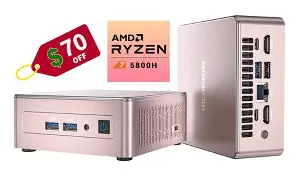
Physically, the A5 Pro follows the now-familiar small-box aesthetic: a dense rectangular chassis designed to sit unobtrusively on a desk or be mounted behind a monitor. The build typically combines metal and plastic to balance heat dissipation and cost. The unit's footprint and height make it suitable where space is at a premium.
Port selection is a key strength for mini PCs, and the A5 Pro usually offers a sensible spread: multiple USB-A and USB-C ports, dual video outputs (HDMI and DisplayPort or dual HDMI in some variants), a 2.5GbE or Gigabit Ethernet jack, audio jack, and at least one M.2 slot exposed internally for NVMe storage. Wi‑Fi 6 (or equivalent recent wireless standards) and Bluetooth are generally included on-board, making the device a self-contained solution for most modern workflows.
Performance and Real-World Use
Performance depends heavily on the configuration chosen. The A5 Pro is typically sold with mobile-class processors that are closer to laptop CPUs than desktop parts. That design choice favors energy efficiency and a small thermal envelope over sustained maximum performance. In everyday tasks—web browsing, office productivity suites, video conferencing, and media streaming—the A5 Pro performs very well: snappy application launches, smooth multitasking with moderate tab counts, and hardware-accelerated video playback for popular codecs.
For content creators working with light photo editing or 1080p video editing, the mini PC is capable but will show limits on export times and multitasking during heavy renders. Developers running local containers, virtual machines, or compilation workloads should pick higher RAM and storage performance options—these workloads stress NVMe throughput and memory capacity more than single-core CPU speed.
Light gaming at 1080p is feasible on integrated graphics. Casual and older titles will run comfortably, but modern AAA titles will need reduced settings to maintain smooth frame rates. The A5 Pro is better viewed as a capable everyday machine with modest gaming or creative bursts rather than a sustained high-performance gaming box.
Thermals and Noise
Small chassis and mobile-class processors mean thermals are a careful balancing act. Under light to moderate loads the A5 Pro is often near-silent and cool. Under sustained heavy load—realistic scenarios like long video exports, extended compile jobs, or CPU-heavy benchmarking—fans ramp up and temperatures rise. Geekom’s thermal tuning typically favors quieter operation, so users may see some thermal throttling under prolonged extreme workloads. For most buyers this is an acceptable trade-off, but those who need consistent peak performance should consider larger systems with dedicated cooling.
Discover deals on Laptops & Computers — updated daily.
Shop Amazon →Storage and Memory
One of the A5 Pro’s advantages is expandability relative to many ultra-compact alternatives. It usually supports at least one M.2 NVMe drive and user-accessible SODIMM slots for RAM. That allows upgrading to faster NVMe storage and increasing memory capacity—important for heavier multitasking, virtualization, or database work. Buyers should choose configurations with fast NVMe storage and adequate RAM for their use case rather than relying on later upgrades, especially if warranty or disassembly complexity is a concern.
Software, OS, and Drivers
The device is commonly shipped with a mainstream operating system installed (Windows or a user-provided Linux option). Driver support for Windows is generally straightforward—network, audio, and graphics drivers are typically available from the vendor or component manufacturers. Linux users can expect varying experiences depending on kernel and driver maturity for Wi‑Fi, audio, and GPU features; community reports indicate that mainstream distributions usually work well after minor tweaks. Buyers who need a specific Linux distribution for production use should verify compatibility and support before purchase.
Real-World Use Cases
- Home office and remote work: The A5 Pro is excellent for document editing, video calls, and multitasking between browser tabs, email, and communication apps. The small footprint frees desk space while still providing multiple USB ports for peripherals.
- Media center / HTPC: With dual-display outputs and hardware video decode, it makes a quiet, capable media player for 4K streaming and local video playback when paired with suitable codecs.
- Developer workstation (light to medium): For web development, local containerized services, and light compile jobs, it can be a compact secondary machine. For heavy builds or large-scale virtualization, a more powerful desktop is preferable.
- Small business kiosks and digital signage: Low power draw, small footprint, and robust connectivity make it a useful option for always-on business applications.
- Light gaming and emulation: Integrated graphics handle emulators and older games well. For modern gaming at higher framerates or resolutions, an external GPU (when supported) or a different class of machine is necessary.
Pros & Cons
- Pros
- Compact design that fits in tight workspaces or behind displays
- Good everyday performance for productivity and media playback
- Reasonable port selection and modern connectivity (USB-C, HDMI/DP, Ethernet, Wi‑Fi)
- Upgradable RAM and NVMe storage in most configurations
- Generally quiet during typical use
- Cons
- Thermal limits can restrict sustained peak performance
- Integrated graphics are limited for high-end gaming or GPU-heavy creative work
- Build quality and long-term support vary between configurations and regions
- Not intended for heavy hardware modification or extreme overclocking
Comparison Table
The table below compares the Geekom A5 Pro to two typical alternatives in the mini-PC space: broadly representative Intel NUC-style units and compact systems from other small-form-factor specialists. The entries are high-level to help match needs rather than list exact specifications.
| Characteristic | Geekom A5 Pro | Intel NUC (compact models) | Other Mini-PCs (e.g., Minisforum-style) |
|---|---|---|---|
| Typical CPU | Mobile-class Intel processors (configurable) | Intel Core (varies from low-power to performance) | Mobile/compact desktop CPUs from Intel/AMD |
| Graphics | Integrated GPU (suitable for everyday and casual gaming) | Integrated or iGPU + discrete options in larger models | Integrated, occasional models with stronger iGPUs |
| Ports & Connectivity | Multiple USB, HDMI/DP, Ethernet, Wi‑Fi, Bluetooth | Similar, often with Thunderbolt in higher-end models | Comparable, sometimes more expansion options |
| Upgradability | SODIMM RAM + M.2 NVMe support in most units | Limited; some models solder RAM, variable storage | Generally similar to Geekom with M.2 + SODIMM |
| Cooling & Noise | Quiet for light loads; fans ramp under sustained load | Varies widely; compact units can be noisier under load | Depends on model; many strike a similar balance |
| Value | Competitive price for features and expandability | Premium pricing for brand and compact engineering | Often competitive; some models are optimized for price |
Buying Guide: How to Decide if the A5 Pro Is Right
When shopping for a mini PC like the Geekom A5 Pro, buyers should evaluate needs across a few concrete dimensions rather than focusing on marketing labels.
1. Define the primary use case
If the machine will primarily run office apps, video calls, web browsing, or serve as an HTPC, even a lower-end A5 Pro configuration will be a good fit. If it will be used for software development with large compiles, heavy container workloads, or professional video editing, prioritize higher CPU tiers, more RAM (16–32GB+), and fast NVMe storage, or consider a larger desktop.
2. Memory and storage choices matter more than CPU burst ratings
Mini PCs often employ CPUs with strong burst performance but limited sustained thermal headroom. For responsiveness, opt for at least 16GB of RAM if multitasking is common, and pick an NVMe SSD for fast app load times and swaps. These upgrades yield more visible day-to-day benefits than marginally faster CPU clocks.
3. Consider connectivity and display needs
Check the specific model’s video outputs and maximum supported display resolutions/refresh rates. Dual-monitor setups are common for productivity; ensure the device supports the necessary outputs and that the integrated GPU can drive the chosen resolutions smoothly.
Discover deals on Laptops & Computers — updated daily.
Shop Amazon →4. Verify OS compatibility and driver support
Windows support is typically straightforward. For Linux deployments, research community reports for the exact configuration—Wi‑Fi chips and audio codecs sometimes require specific kernel versions or firmware blobs.
5. Long-term support, warranty, and region-specific service
Compact vendors can vary in warranty lengths and the ease of obtaining spare parts. Confirm warranty terms and local support options if uptime matters for business use.
6. Noise and thermal expectations
If a near-silent system is a priority (for recording or bedroom use), look for real-world user reports on fan noise under similar workloads. Be prepared to accept thermal throttling if the device is tuned for acoustics.
Practical Tips Before Purchase
- Choose a configuration with upgradeable RAM and NVMe storage if future-proofing matters.
- Read user reviews that describe sustained workload behavior—synthetic benchmarks can be misleading for compact systems.
- If planning a dual-boot or Linux-only setup, verify Wi‑Fi and audio chip compatibility for the exact SKU.
- Consider purchasing slightly higher specifications than currently needed if using the device as a long-term workstation—upgrading small systems later can be more fiddly than expected.
Conclusion
The Geekom A5 Pro mini PC represents a pragmatic, space-saving choice for the majority of users who need a capable, unobtrusive desktop. It excels at office work, media playback, and general-purpose computing, offering a useful combination of ports, upgradability, and performance for day-to-day workflows. The main compromises stem from its small size: thermal limits that affect sustained peak performance and integrated graphics that are not suited for serious GPU-bound workloads.
For buyers who prioritize small physical footprint, quiet operation, and solid everyday responsiveness—especially for remote work, home theaters, or light development—the A5 Pro is a compelling option. Those who require sustained heavy compute, high-end gaming, or extensive internal expansion will be better served by a traditional desktop or a larger mini PC with more aggressive cooling and discrete graphics options. Ultimately, the A5 Pro’s value depends on matching the chosen configuration to realistic use cases rather than chasing headline benchmark numbers.