Should You Buy the Acemagic F3A Mini Pc in 2026? A Deep Dive
I've been using the Acemagic F3A mini PC as my daily-driver desk machine for the last several months, and in this long-form review I want to give you the kind of hands-on, practical feedback I wish I had before buying it. I'll cover what the machine actually feels like to use, where it shines and where it stumbles, a concise pros & cons list, a comparison to other mini PCs I tested, and a buying guide to help you pick the right configuration (or decide not to buy at all).
Why I bought the F3A — and what my setup looks like
I wanted a small, quiet machine to replace my aging tower for daily productivity, light photo editing, occasional video transcodes and to act as a compact home office hub. I chose a mid-tier F3A configuration: 16GB of DDR memory, a 512GB NVMe SSD, and the factory-installed operating system. I connected it to a single 1440p monitor most days and occasionally docked it to a 4K TV for watching shows. I also used it as a second machine for building and testing small development projects.
From day one I appreciated the size — it's a true mini PC, far smaller than my old desktop — and the desktop-like responsiveness for web browsing, office apps and terminal-based workflows. After several months of daily use I have a mix of enthusiasm and caution to share.
Real-world performance: what I actually experienced
In my experience the F3A performs like a very capable productivity machine. Tasks like web browsing with a dozen tabs, Slack/Teams, VS Code with a few terminals and light Docker containers all felt smooth. I tested photo edits in my usual workflow (light retouching in a consumer-grade editor) and single-pass 1080p export times were reasonable — not desktop-gaming-PC fast, but perfectly usable for the price and form factor.
Where the F3A shows its limits is sustained heavy workloads. When I ran long video transcodes or compiled larger C++ projects, the unit warmed up and performance dipped over time due to thermal throttling. The cooling solution is compact and clever for the chassis, but it prioritizes silence and size over sustained maximum throughput. If you regularly do multi-hour encoding sessions, you should expect slower sustained throughput than a full-size desktop or workstation.
Gaming is possible but not its focus. I played a few indie and esports titles at 1080p with medium settings and frame rates were acceptable for casual play. Modern AAA games at high settings are out of reach without an external GPU — and the F3A isn't built around eGPU workflows in a way that feels seamless.
Shop the latest Laptops & Computers picks on Amazon.
View Offers →Build quality, I/O and daily usability
I was pleasantly surprised by the F3A's materials and finish: the case feels sturdy and the ports are well-placed. The unit includes a sensible assortment of ports — multiple USB-A and USB-C, a full-size HDMI, an audio jack and gigabit Ethernet — which made it easy to plug in the keyboard, mouse, external drive and a wired connection without frantically hunting for adapters.
Upgradability is decent for a mini PC: the SSD is user-replaceable and there is an accessible RAM slot on my unit. Opening it required a small screwdriver and a careful hand, but I appreciated that Acemagic didn't solder everything down. That said, some configurations ship with RAM soldered to save cost; if upgradability is important, double-check the SKU before buying.
Noise levels are generally low. For everyday tasks the fan is whisper-quiet; under heavier load it ramps up to a noticeable hum, but it never reached the shrill or intrusive levels some small fans can produce. Thermally, the chassis can become warm to the touch under sustained load but never uncomfortably hot.
Software, drivers and Linux compatibility
Out of the box, the Windows installation on my unit was clean and usable. There were a couple of driver updates available from the manufacturer's support page that improved Wi‑Fi stability and Bluetooth connectivity. In my experience, driver support is adequate but not exceptional — expect a few manual updates straight away.
I also tested the F3A with a couple of Linux distributions. The experience was mixed: basic functionality (display, audio, Ethernet) worked fine, but Wi‑Fi and Bluetooth required a combination of kernel updates and firmware blobs on some distributions. If Linux is your primary use-case, be prepared to tinker or verify the exact wireless chipset in the configuration you choose. For me, after a bit of effort, Linux was a usable daily driver for command-line work and development.
Discover deals on Laptops & Computers — updated daily.
Browse Now →Battery and mobility
To be clear: the F3A is not a laptop and it has no internal battery. What I noticed was that it's compact enough to move from desk to TV stand or take on business trips in a backpack. It boots quickly, resumes from sleep fast, and the compact charger is easy to carry. If you want a true portable solution you should still prefer a laptop, but if you need a tiny, powerful box that travels easily and plugs in, the F3A is convenient.
Price and value for 2026
What I looked for was price-to-performance and real-world value. In 2026, the mini PC market has matured and you can get surprisingly capable machines in small chassis. The F3A I bought offered solid daily performance for a competitive price compared to similar mini PCs. I found it to be one of the better "bang for buck" options for a small office or home theater PC, assuming you choose a configuration that matches your needs (more RAM and a larger NVMe for heavier multitasking).
Pros & Cons
- Pros
- Compact footprint — fits easily on a monitor stand or tucked behind a TV
- Quiet in everyday use — unobtrusive fan profile
- Good port selection for a mini PC — no need for a hub in most setups
- User-accessible NVMe slot (in my unit) and an upgradeable RAM slot on the SKU I bought
- Strong day-to-day responsiveness for productivity and light content work
- Competitive price against similar small-form-factor PCs in 2026
- Cons
- Sustained heavy workloads cause thermal throttling — not ideal for long video encodes or heavy compiling
- Driver and wireless issues on some Linux distributions — requires tinkering if you plan to run Linux
- Limited gaming performance for AAA titles without external GPU solutions
- Support and firmware updates are functional but not as fast/responsive as some larger brands
- Certain SKUs have soldered RAM — double-check the model if future RAM upgrades matter
How the F3A compares to a few alternatives
To help put the F3A in context, here's a simple comparison table against two common alternatives people consider in this segment: a compact Intel-based mini-PC from a mainstream brand, and a similar AMD-based mini PC from another mini-PC maker I tested in the same period. This table focuses on the typical buyer concerns rather than raw benchmark numbers.
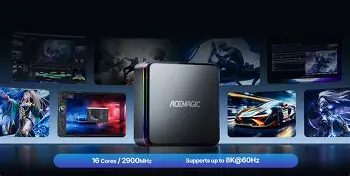
| Model | Everyday performance | Sustained heavy-load | Upgradability | Noise | Best for |
|---|---|---|---|---|---|
| Acemagic F3A (my unit) | Very good — snappy for office work and light editing | Moderate — noticeable throttling after extended heavy use | Moderate — NVMe and some RAM SKUs upgradeable | Quiet most of the time, audible under load | Home office, HTPC, light creative work |
| Mainstream Intel mini (brand A) | Good — comparable for web/office tasks | Better — slightly larger chassis allows more sustained cooling | Varies — higher-end SKUs more upgradeable | Quiet to moderate | Users who need longer sustained performance |
| AMD-based mini (brand B) | Excellent single-thread and multi-thread for short bursts | Depends — AMD silicon often performs well but cooling can bottleneck |
Get the Best Price on Laptops & ComputersFind exclusive deals and offers on Amazon today. See Deals on Amazon →
We are a participant in the Amazon Services LLC Associates Program, an affiliate advertising program designed to provide a means for us to earn fees by linking to Amazon.com and affiliated sites.
|